Growth Engine: is the promotion paying off?
A tool for a two-person team launching a product nobody knows yet. It answers the three questions that matter in the first weeks: where are we promoting it, what is that costing, and is anything coming back? I designed it and built it with Claude over a weekend, after throwing my first version away. It hasn’t been used on a real launch yet.
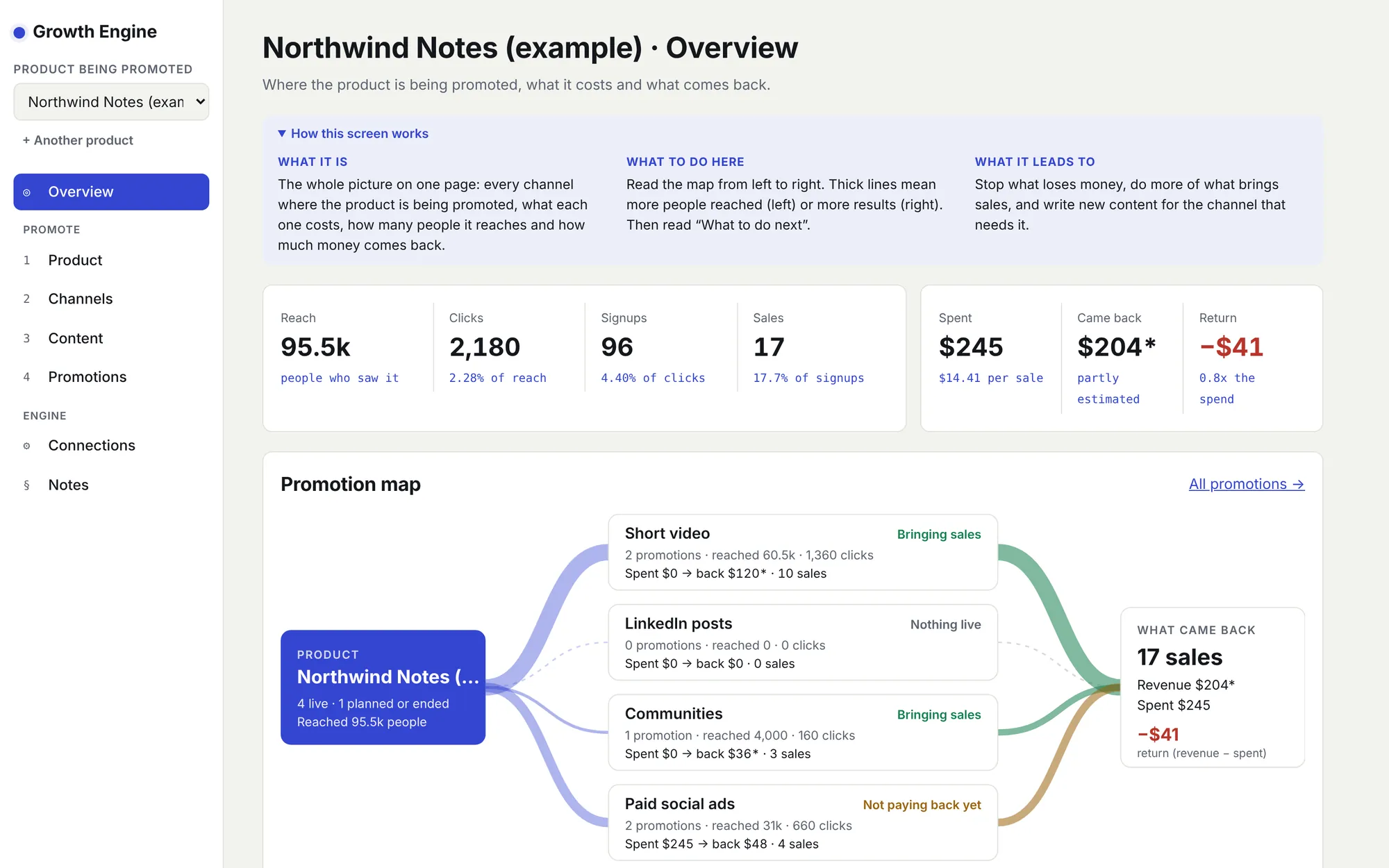
A week into a launch, a small team can’t say where the product was promoted, what it cost or what came back.
Cut my own 11-screen design down to 6, each answering one question, ending in a map from the product to every channel to what came back.
Built and tested. The first real launch is set up, so there are no sales numbers yet.
Context
A new product that nobody knows yet has one job: get in front of buyers and make the first sales. For a two-person team the hard part isn’t posting. It’s knowing, a week later, where the product was promoted, what it cost and what came back, without a spreadsheet and six dashboards.
I wanted one place that answers that, and that a beginner and an expert can both read.
Every screen on this page uses an invented example product, Northwind Notes. No real product data appears here.
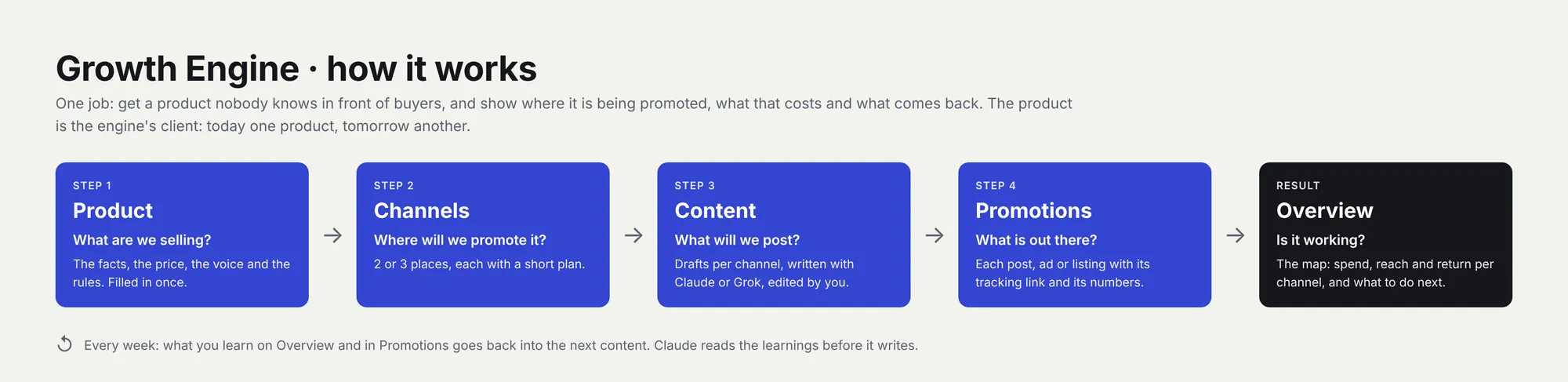
Four steps, one result. Every week, what you learn goes back into the next content.
The first version
My first design had 11 screens: an inbox, agents, a video studio, experiments with verdict rules, a weekly review and more. It looked complete, and it confused everyone who saw it, me included. It mixed up two things: the product being sold and the engine that promotes it.
The turning point was one sentence: the product is the engine’s client. Today it’s one product; tomorrow it can be another. Once the engine stopped being about a single product, most of those screens had no job left. I removed five of them and rewrote the rest.
The rule I kept after that: each screen answers one question. If a screen stops answering its question, it goes.
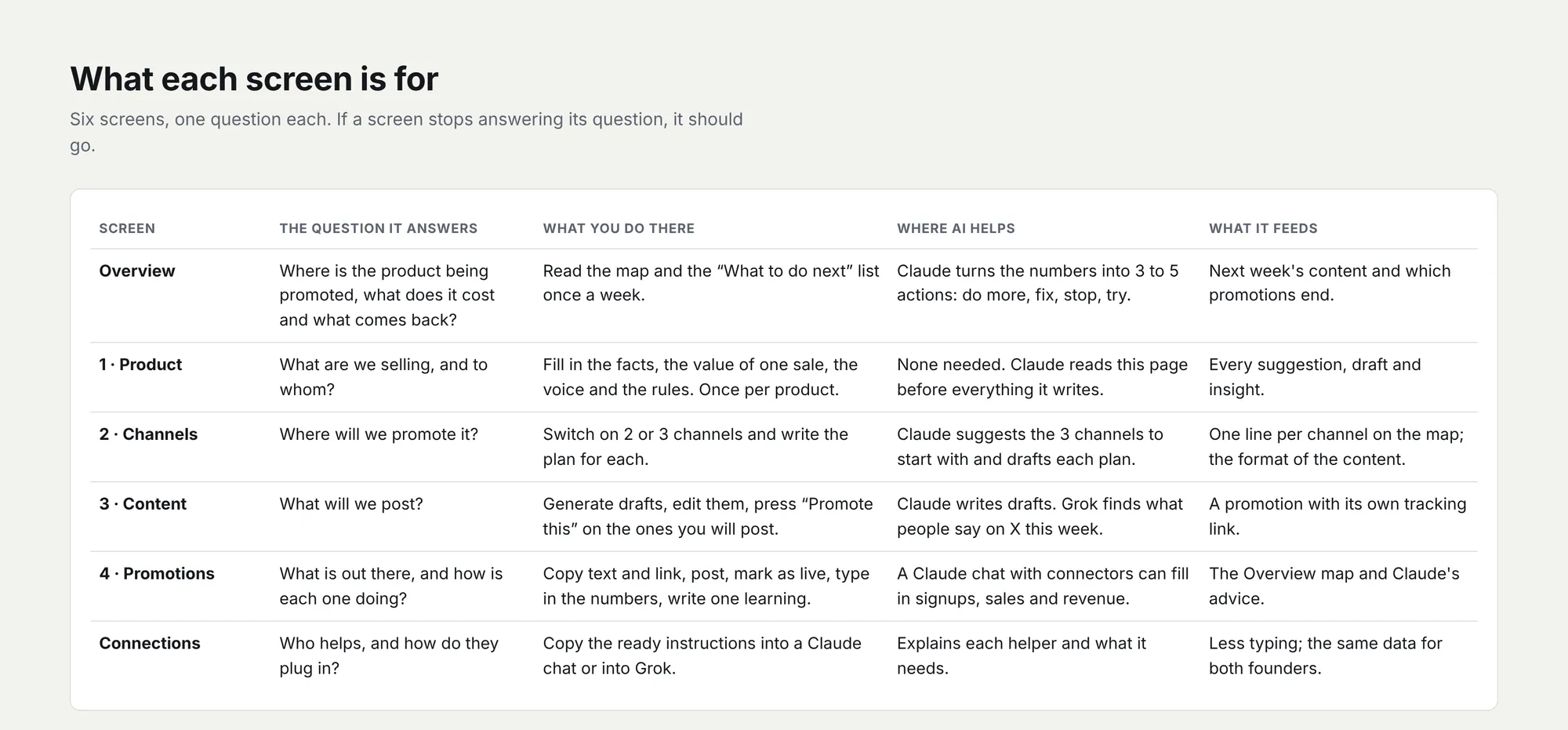
Six screens, one question each.
How it works
Product
What are we selling, and to whom? The price, the voice and the rules, filled in once. Every suggestion and draft the engine writes starts here.
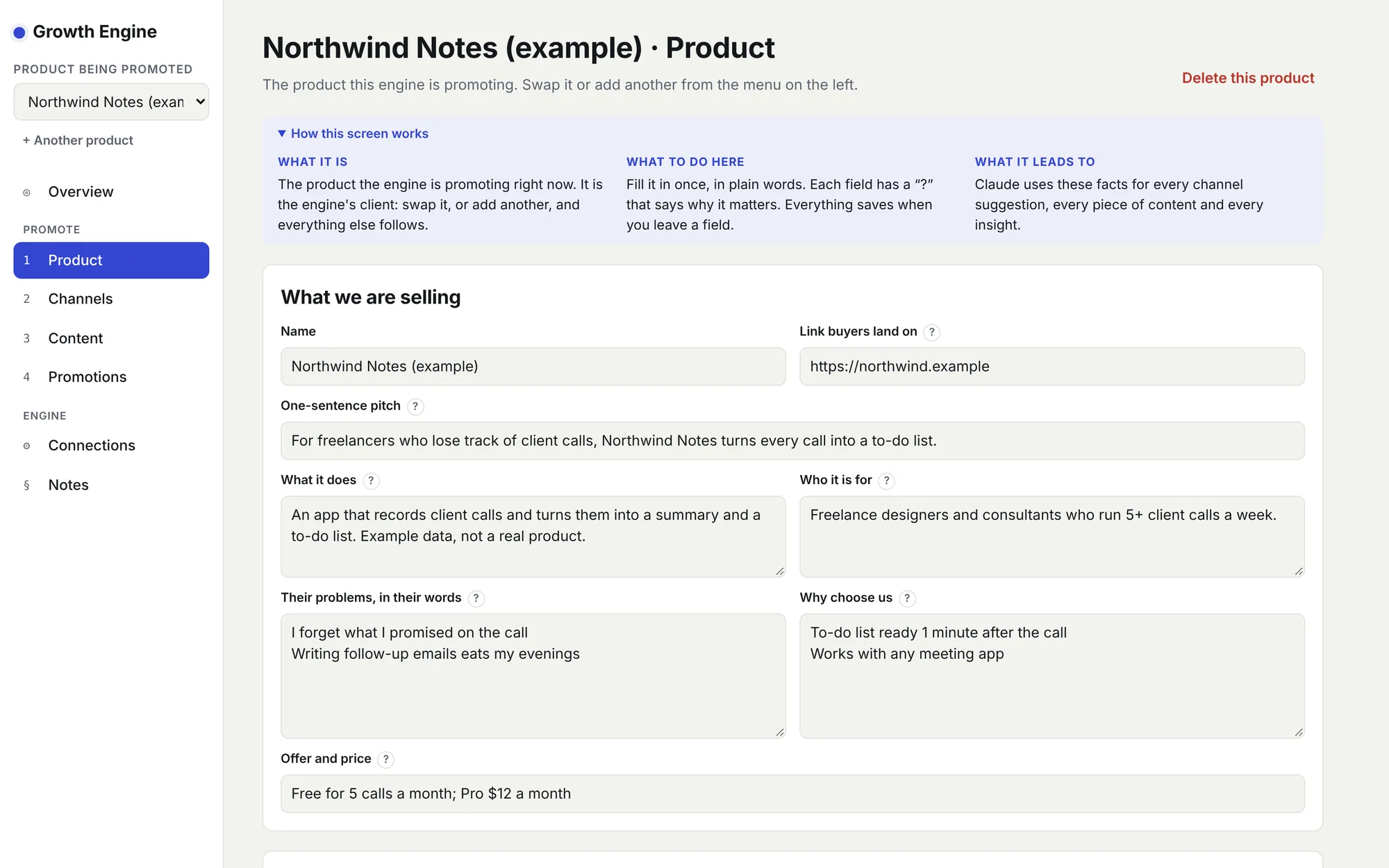
Product, filled in once. Example product, invented data.
Channels
Where will we promote it? Two or three places, each with a short plan. Of the 18 channels in the list, 13 are free, and the tool warns you when more than three are on: two people rarely do more than that well.
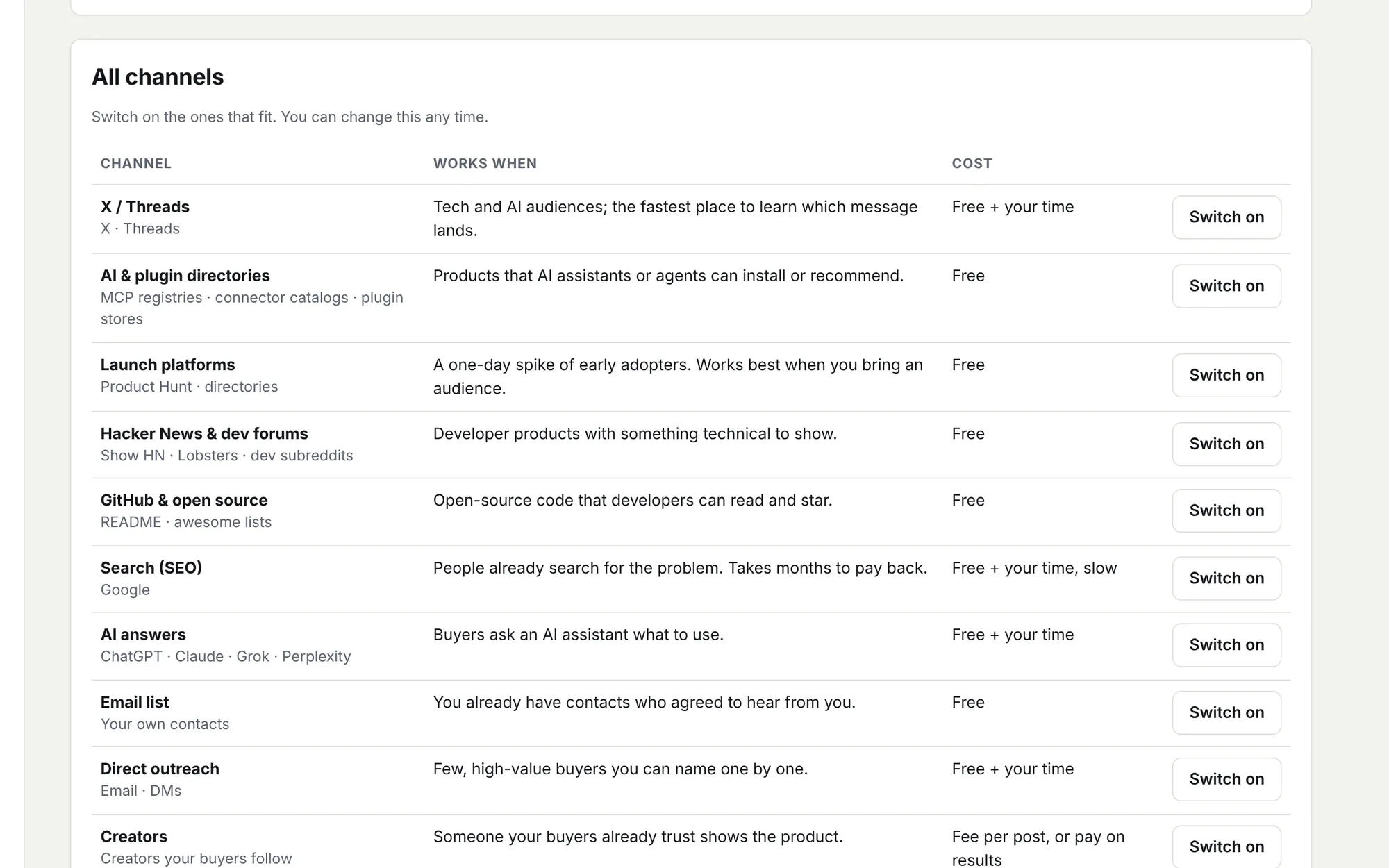
All channels, with when each one works and what it costs.
Content
What will we post? Claude or Grok drafts a post for each channel, in the product’s voice. A person edits it and decides what goes out.
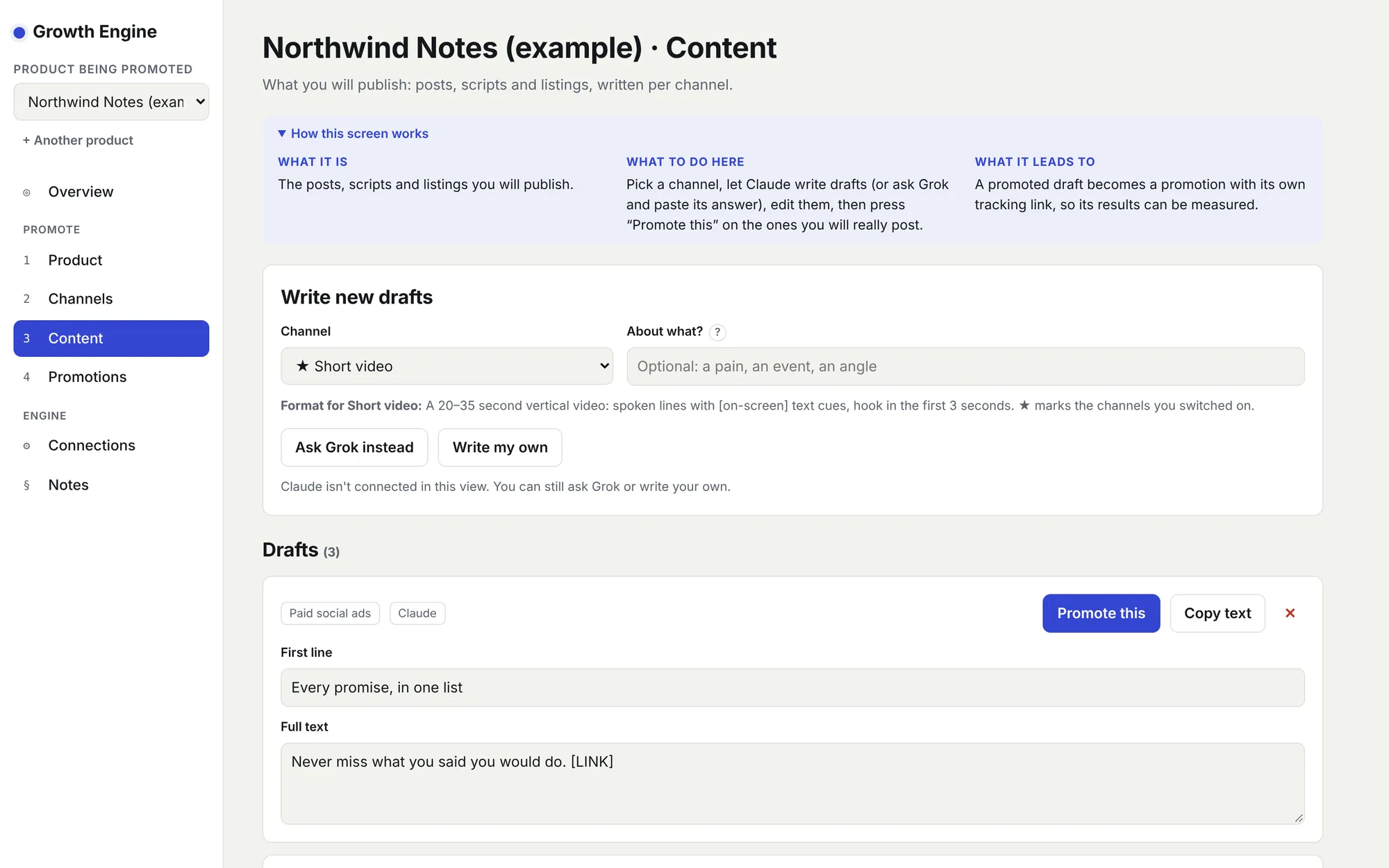
Drafts per channel, edited by a person. Example data.
Promotions
What’s out there, and how is each one doing? Every post, ad or listing gets its own tracking link and its own numbers, from spend to revenue.
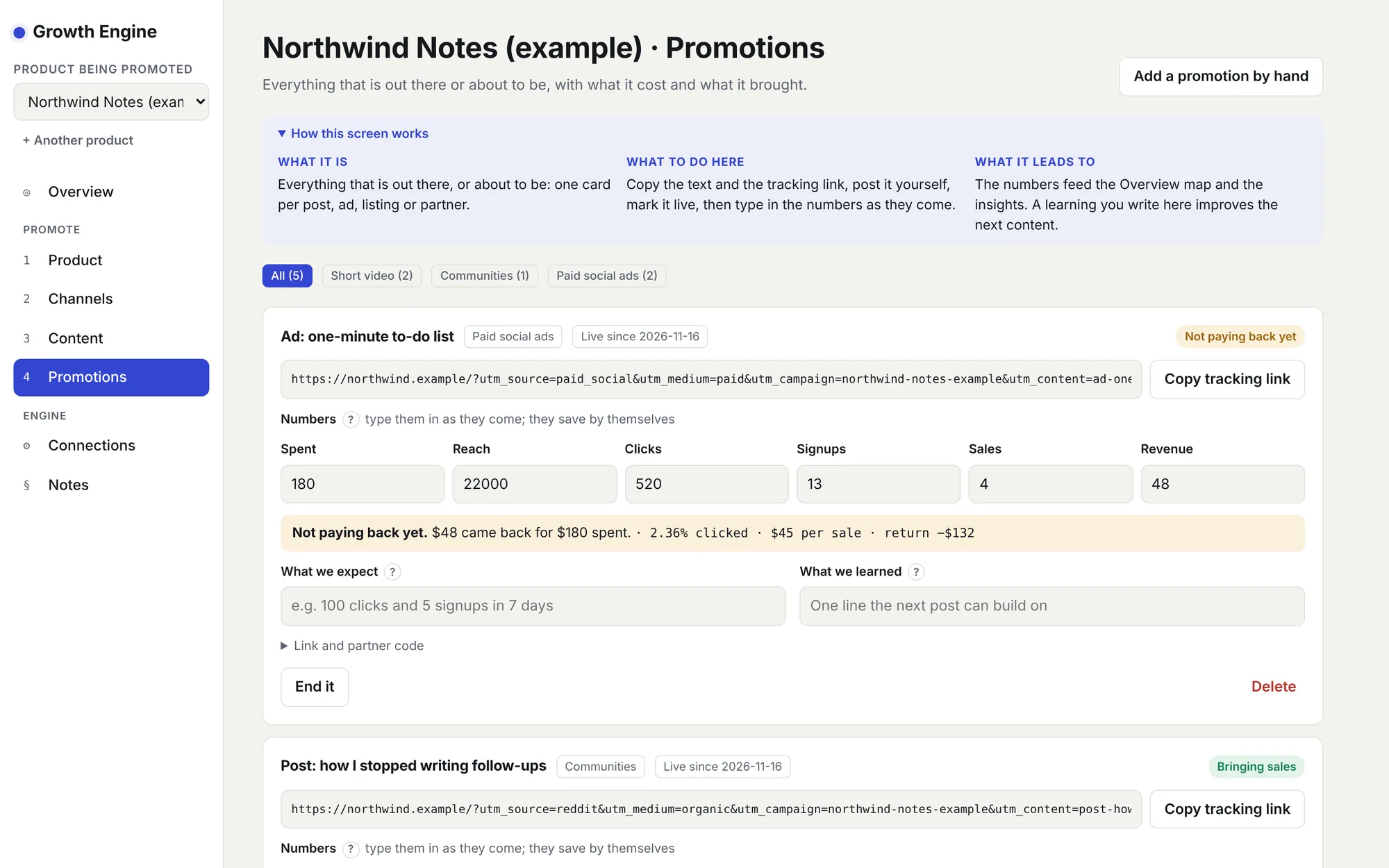
Each promotion with its own link and numbers. Example data.
Overview
Is it working? A map from the product to each channel to what came back, a status per channel in plain words, and a short list of what to do next week.
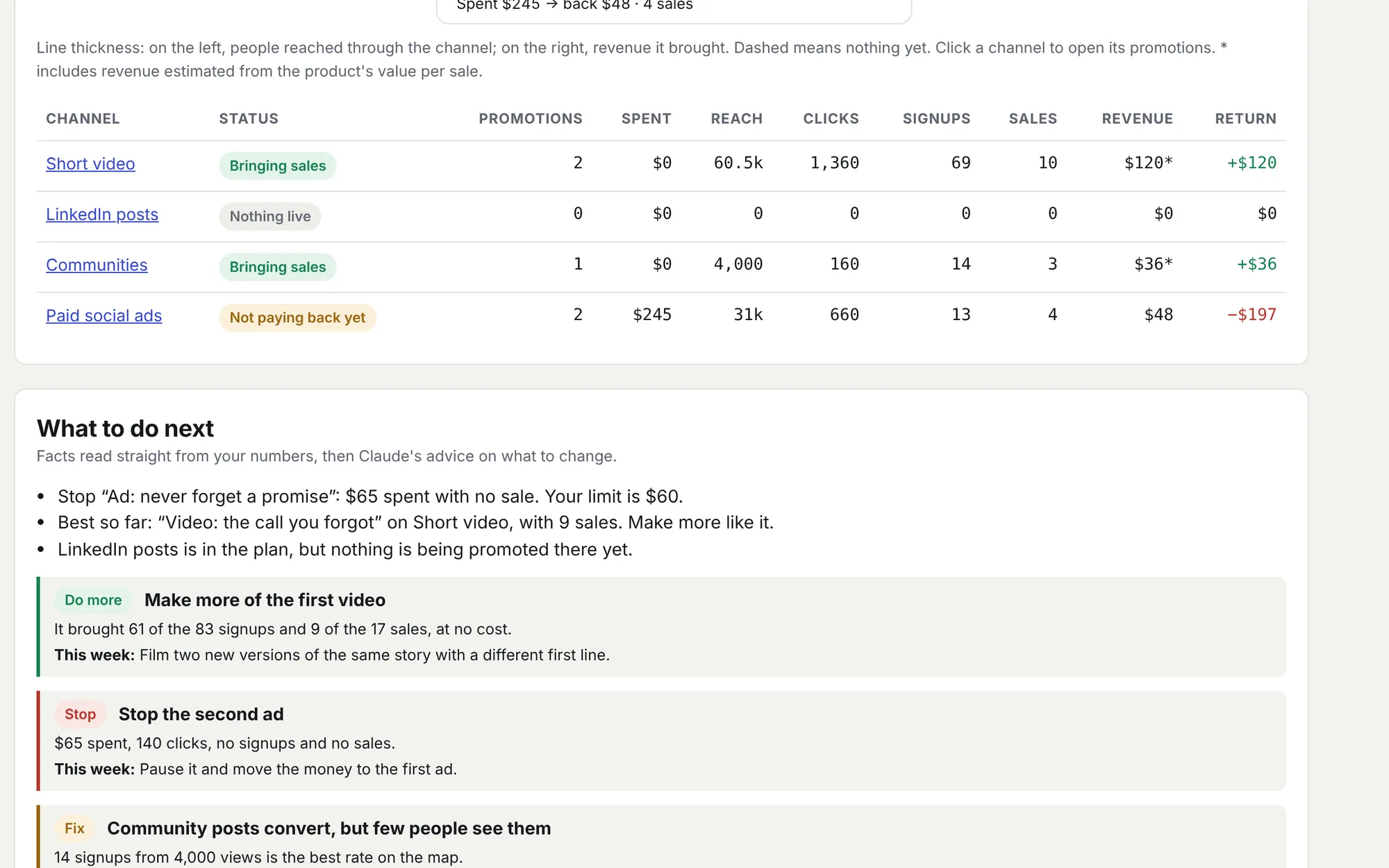
The numbers per channel, and what to do next. Example data.
Decisions
The Overview draws promotion as a flow. On the left, line thickness is people reached; on the right, it’s revenue. You see which channel earns and which one only costs.
Statuses read Bringing sales, Not paying back yet or Stop. There’s no health score. The only rule is one the team sets: stop a promotion once it spends a set amount with no sale.
If revenue isn’t typed in, it’s estimated as sales times the value of one sale, and marked with an asterisk. An empty field stays empty.
Every screen opens with how it works: what it is, what to do, what it leads to. Every field that needs it has a question mark that says why it matters.
Claude suggests channels, drafts content and turns the numbers into a few actions. Grok brings what people said on X. The engine never posts, sends or spends money.
It’s an internal tool, so every part had to work on free tiers. Connectors fill in signups, sales and revenue, so there’s less to type.
Before designing, I asked Claude to research and to name the source and date of every number. Published benchmarks are given to the AI as reference points, with their sources, not used as rules the tool enforces. Where no data was found, the notes say so. Paid channels come late: only after a message already works for free.
How I’ll know it works
There are no results yet, and the first real week will teach me more than any test. All six screens and every flow are built and pass an automated test run. After that week, these are the questions I’ll answer:
Which channels bring sales, and which only cost? That’s the job of the Overview, so it’s the first thing to check.
Did the “what to do next” list change what we posted? If nobody acts on it, it’s decoration.
Which screens did nobody open? The same rule as the first cut: a screen that answers nothing for two weeks goes.
The first real launch is set up, with its channels chosen and its first promotions written. I’ll add what came back here.
Takeaway
My first version had everything in it and answered nothing. One sentence fixed it: the product is the engine’s client. I should have written that sentence before drawing a single screen.
I’ll only know if these six screens are right after the first real week. Until then, it’s a well-tested guess.
Building with AI went fastest when the rules were fixed before the first prompt: one question per screen, no invented numbers, and a person decides and posts.